The Mom’s AI Income Blueprint — Build an Online Income Around Your Family
For Moms
Build an Online Income Around Your Family, Not the Other Way Around
A calm, step-by-step path for moms who want to learn AI, Pinterest marketing, and affiliate income, fit into naptime, not your whole life. No tech background required.
Every digital marketer has been there! You open ChatGPT or Claude, type something like “write me a blog post about email marketing,” and get back content so bland it could put a caffeine addict to sleep.
The problem isn’t the AI. It’s the prompt.
The difference between mediocre AI output and content that actually ranks, converts, and sounds like a human wrote it comes down to one thing: how you ask. Vague prompts produce vague results. Specific, structured prompts produce work you can actually use.
In this post, I’m sharing the best AI prompts for digital marketers across eight categories plus five completely free ones you can steal right now. Whether you’re running a blog, managing social media, building an email list, or running paid ads, there’s something here for you.
Why Most AI Marketing Prompts Fail
Before we get into the prompts, it’s worth understanding why so many people get disappointing results from AI tools.
Most prompts fail because they’re missing three things:
1. Context : AI doesn’t know your audience, niche, tone, or goal. Without that context, it defaults to generic.
2. Structure : Telling the AI what to produce isn’t enough. You need to tell it how to structure the output so it’s immediately usable.
3. Specificity : “Write a social media post” is too open. “Write a LinkedIn post under 1,300 characters with a bold opening statement, three actionable insights, and a question to drive comments” gives the AI a blueprint to follow.
The prompts below solve all three problems. Each one includes context, a clear structure, and specific instructions so you get output worth using.
The 8 Categories of High-Performance Marketing Prompts
A complete marketing operation touches a lot of different channels. Here’s what the best AI prompt workflow covers:
Content creation (blogs, articles, scripts)
SEO and keyword research
Social media content
Email marketing
Paid advertising
Sales and conversion copy
Business productivity and operations
Affiliate marketing
Let’s dig into each category with real, usable prompts.
Content Creation Prompts
Content is the engine of most digital marketing strategies and it’s one of the most time-consuming parts of the job. These prompts speed up the entire process without sacrificing quality.
Free prompt #1: Blog post outline generator
Create a detailed blog post outline for the topic: [TOPIC]. Target audience: [AUDIENCE]. Include an attention-grabbing H1, 5–7 H2 subheadings with 2–3 bullet points each, a compelling intro hook, and a strong CTA. Optimize for the keyword: [KEYWORD].
This prompt is the starting point for any long-form piece. Instead of writing from a blank page, you get a ready-made structure that’s already optimized for your target keyword. Fill in the topic, audience, and keyword, and you’ll have a complete blog framework in under a minute.
Use it for: Blog posts, pillar pages, long-form articles
Free prompt #2: Content repurposing machine
Take this existing blog poTitle Page Separator Site titlest: [PASTE CONTENT]. Repurpose it into: (1) a 280-character tweet, (2) a LinkedIn post with 3 key takeaways, (3) a 60-second video script, and (4) 5 Instagram carousel slide captions. Keep the core message consistent.
So this one prompt extracts four pieces of content from a single source. If you’re publishing one blog post per week, this prompt alone could fill your entire social media calendar without writing anything from scratch.
Use it for: Multi-channel content strategies, content repurposing workflows
Other content prompts worth having
Beyond these two freebies, high-output marketers also use prompts for:
Writing three different intro paragraph styles (shocking statistic, relatable story, bold claim) to A/B test engagement
Building full content briefs with search intent, competitor angles, and recommended word counts
Generating 10 SEO-optimised FAQ questions and answers for any topic
Writing compelling case studies in a structured challenge → solution → results → takeaways format
SEO and Keyword Research Prompts
AI won’t replace your SEO tools, but it dramatically speeds up the strategy work clustering keywords, writing meta copy, and identifying content gaps.
Free prompt #3: Keyword cluster builder
I run a website about [NICHE]. Generate a keyword cluster around the seed keyword [KEYWORD]. Include: 5 short-tail keywords, 10 long-tail variations, 5 question-based keywords, and 3 buyer-intent keywords. Format as a table with search intent (informational/commercial/transactional).
One of the most tedious parts of SEO content planning is keyword research. This prompt gives you a structured cluster including buyer intent terms that are often overlooked in seconds. The table format means you can drop it straight into a content calendar.
Use it for: Content strategy, topic clustering, editorial planning
Other useful SEO prompts in a complete pack include schema markup generation (JSON-LD for articles), SEO title tag variations using proven click-through formulas, internal linking strategy recommendations, and meta description writing across three conversion-focused angles.
Social Media Prompts
The hardest part of social media isn’t posting it’s generating fresh ideas consistently. These prompts solve the blank-page problem for every platform.
Free prompt #4: Viral hook formula
The hook is 80% of the battle on any social platform. This prompt generates 10 different approaches, so instead of guessing what will stop the scroll, you have a menu of options to test. Run the top three and see what your audience responds to.
Use it for: LinkedIn, Instagram, TikTok, X (Twitter)
Rounding out the social media category, other essential prompts cover: 30-day content calendars (with content type, post theme, and caption direction), Twitter/X threads formatted 1/10 to 10/10, platform-specific Instagram caption styles, and full TikTok scripts with stage directions and timing cues.
Email Marketing Prompts
Email remains one of the highest-ROI channels in digital marketing and also one of the most demanding in terms of consistent output. These prompts cover the full lifecycle from welcome sequences to re-engagement campaigns.
Free prompt #5: Welcome email sequence
Write a 5-email welcome sequence for new subscribers of [BRAND NAME] in the [NICHE] space. Email 1: warm welcome + deliver freebie. Email 2: your story/why. Email 3: biggest value tip. Email 4: address top objection. Email 5: soft pitch for [PRODUCT]. Include subject lines for each.
A great welcome sequence is the difference between a list that buys and one that goes cold. This prompt outputs the full five-email arc with subject lines covering relationmon objections mapped with a one-sentence acknowledgment, a two-sentence reframe, and a proof point for each. This alone is worth building into your sales page and any live sales calls.
Sales page writer — A full long-form sales page structure covering headline, hook story, probship building, value delivery, objection handling, and a soft conversion moment. It’s one of the highest-leverage prompts in any email marketer’s toolkit.
Use it for: Email list nurturing, new subscriber onboarding
The email category also extends to subject line A/B testing (with 10 variations across five psychological trigger types), re-engagement campaigns for lapsed subscribers, 7-email product launch sequences, weekly newsletter templates, and cold outreach emails under 150 words.
Paid Advertising Prompts
Writing ad copy from scratch is one of the most expensive ways to spend a copywriter’s time. These prompts give you a starting framework across every major ad format.
Facebook and Instagram, the best approach is a three-angle structure: pain-point focused, dream outcome focused, and social proof focused. Having all three ready lets you test different psychological hooks without briefing a copywriter for each variation.
For Google Search, headline prompts that produce 15 variations under 30 characters (across benefit, feature, and urgency angles) keep your ad groups fresh for testing.
The re-targeting category is especially valuable prompts that write short ads specifically addressing the three most common purchase objections (price, trust, and timing) with built-in urgency elements.
Sales and Conversion Prompts
Getting traffic is only half the job. These prompts help turn visitors into buyers.
The most used prompts in this category:
Objection handler — Input your product, price, and audience, and get the seven most common objections mapped with a one-sentence acknowledgment, a two-sentence reframe, and a proof point for each. This alone is worth building into your sales page and any live sales calls.
Sales page writer — A full long-form sales page structure covering headline, hook story, problem section, features-to-benefits list, social proof placeholders, objection handling, urgency element, and CTA. Fill in the variables and you have a complete first draft.
Price anchoring script — Structures your pricing section using value stacking, daily cost breakdown, bonus listing, and a “what you get today” summary. Particularly useful for digital products and online courses.
AI Productivity Prompts
Beyond marketing output, AI is genuinely useful for the operational side of running a business. Prompts in this category cover:
Business idea validation — Acts as a skeptical investor to analyse market size, competition, revenue streams, and risks, rated out of 10 with reasoning
SOP creator — Produces a full standard operating procedure for any repeatable task, formatted so a new team member can follow it independently
Weekly review template — A structured 15-minute review covering wins, revenue vs goal, blockers, lessons learned, and next week’s priorities
Client onboarding sequence — The full new client workflow including welcome email, intake questionnaire, kickoff agenda, and first-week check-in
Affiliate Marketing Prompts
Affiliate content lives or dies on trust and specificity. Vague reviews don’t convert. These prompts produce the structured, honest content that earns clicks.
A comparison post framework is particularly strong and it outputs a complete “[Product A] vs [Product B]” article with a TL;DR verdict, comparison table, deep-dive sections, use-case scenarios, and a final recommendation with affiliate CTA. Comparison posts consistently rank well and have high commercial intent, making them among the most valuable pages in any affiliate site.
The bonus stack creator is another standout: input an affiliate product and price, and get five complementary bonuses with names, descriptions, perceived dollar values, and explanations of how each bonus complements the main product. This is the kind of offer architecture that separates average affiliate pages from ones that actually convert.
How to Get Better Results From Any AI Prompt
A few principles that apply regardless of which prompts you use:
Replace every variable. The [BRACKETED] placeholders are there for a reason. The more specific you are with your actual niche, audience, product name, and tone — the more usable the output will be.
Iterate, don’t accept the first draft. AI output is a first draft, not a finished product. Follow up with: “Make the tone more conversational,” “Shorten this by 30%,” or “Add a stronger sense of urgency to the CTA.”
Save your best outputs as templates. When a prompt produces something great, but save both the prompt and the output. Over time you’ll build a swipe file of your best-performing AI-generated copy.
Combine prompts. Use the blog outline prompt to structure an article, then run the intro paragraph prompt on each section, then the FAQ generator for the bottom of the post. Prompt chaining produces far better output than using any single prompt in isolation.
Get All 50 Prompts in One Place ( Oh 8 are Free! )
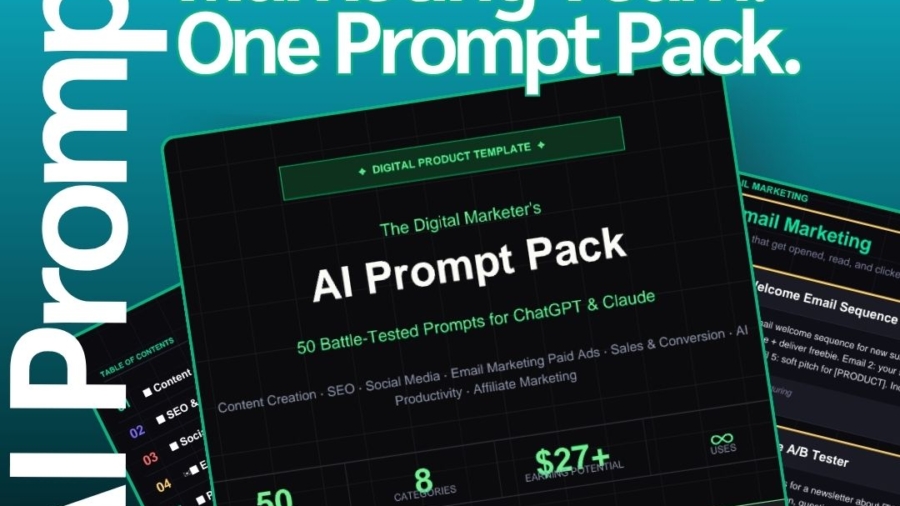
The five free prompts above are pulled from a complete pack of 50 battle-tested marketing prompts covering all eight categories: content creation, SEO, social media, email marketing, paid advertising, sales and conversion, AI productivity, and affiliate marketing.
Each prompt is plug-and-play, works with ChatGPT and Claude, and is designed to produce output you can actually use — not just something that sounds right but needs a full rewrite.
The Digital Marketer’s AI Prompt Pack
✦ NR23 Digital Marketing
The Digital Marketer’s AI Prompt Pack
50 battle-tested ChatGPT & Claude prompts for content creation, SEO, social media, email marketing, and paid ads — built for marketers who want results fast.
50
Prompts
8
Categories
∞
Uses
$27
One-time
Sample Prompts Included
Blog Post Outline Generator
🔥 HotContent
Create a detailed blog post outline for the topic: [TOPIC]. Target audience: [AUDIENCE]. Include an attention-grabbing H1, 5–7 H2 subheadings with 2–3 bullet points each, a compelling intro hook, and a strong CTA at the end. Optimize for the keyword: [KEYWORD].
Content Repurposing Machine
⚡ ProContent
Take this existing blog post: [PASTE CONTENT]. Repurpose it into: (1) a 280-character tweet, (2) a LinkedIn post with 3 key takeaways, (3) a 60-second video script, and (4) 5 Instagram carousel slide captions. Keep the core message consistent across all formats.
SEO Meta Description Writer
✦ NewSEO
Write 3 variations of SEO meta descriptions for a page about [TOPIC]. Each must be under 155 characters, include the primary keyword [KEYWORD], contain a clear benefit, and end with a subtle CTA. Target audience: [AUDIENCE].
Keyword Cluster Builder
⚡ ProSEO
I run a website about [NICHE]. Generate a keyword cluster around the seed keyword [KEYWORD]. Include: 5 short-tail keywords, 10 long-tail variations, 5 question-based keywords (who/what/how/why), and 3 buyer-intent keywords. Format as a table with estimated search intent (informational/commercial/transactional).
Viral Hook Formula
🔥 HotSocial
Write 10 scroll-stopping hooks for a social media post about [TOPIC]. Use these proven formats: curiosity gap, bold claim, contrarian take, “X mistakes” list, personal story opener, and surprising statistic. Platform: [PLATFORM]. Audience: [AUDIENCE].
30-Day Content Calendar
⚡ ProSocial
Create a 30-day social media content calendar for a [BUSINESS TYPE] in the [NICHE] niche. Include post themes, content types (reel, carousel, story, static), posting days, and a one-line caption idea for each. Mix: 40% educational, 30% engaging/fun, 20% promotional, 10% testimonials/social proof.
Welcome Email Sequence
🔥 HotEmail
Write a 5-email welcome sequence for new subscribers of [BRAND/BLOG NAME] in the [NICHE] space. Email 1: warm welcome + deliver freebie. Email 2: your story/why. Email 3: biggest value tip. Email 4: address #1 objection. Email 5: soft pitch for [PRODUCT/SERVICE]. Include subject lines for each email.
Facebook Ad Copy (3 Angles)
✦ NewAds
Write Facebook ad copy for [PRODUCT/SERVICE] targeting [AUDIENCE]. Create 3 versions using different angles: (1) Pain-point focused, (2) Desire/dream outcome focused, (3) Social proof/results focused. Each version needs: a hook (first line), body copy (3–4 sentences), and a CTA. Keep each under 150 words.
Get the Full Pack
One-Time Purchase
$20
Instant PDF
50 done-for-you AI prompts
8 marketing categories covered
Works with ChatGPT & Claude
Fill-in-the-blank variable format
Lifetime access + free updates
Whether you’re a solo blogger, a freelancer managing multiple clients, or an in-house marketer trying to do more with less, having the right prompts on hand is one of the highest-leverage investments you can make in your workflow.
Stop writing from scratch. Start with prompts that work.
In today’s digital-first world, the question for small business owners is no longer if they need a website, but rather how quickly they can get one. As we move further into 2026, a professionally designed website is not just a digital brochure, it’s the cornerstone of your business’s online presence, a 24/7 salesperson, and a powerful engine for growth. This guide will explore the essential benefits of having a website for your small business and how to leverage it to thrive in the age of AI-powered search.
The Unwavering Importance of a Professional Website
While social media platforms are valuable for engaging with customers, they are ultimately “rented land.” You don’t own your social media profiles, and you’re subject to the whims of algorithm changes and platform policies. A website, on the other hand, is your digital property. It’s an asset that you control, a central hub for all your marketing efforts, and a space where you can build a lasting brand identity.
Building Trust and Credibility in the Digital Age
A recent study found that a significant majority of consumers expect businesses to have a website. A well-designed and informative website instantly builds trust and credibility with potential customers. It signals that you are a legitimate and professional operation, which is crucial for converting prospects into loyal patrons. Without a website, you risk being perceived as outdated or untrustworthy, sending potential customers straight to your competitors.
Your 24/7 Sales and Marketing Engine
Imagine having a salesperson who works around the clock, never takes a vacation, and can speak to thousands of customers at once. That’s what a website does for your business. It’s a tireless advocate that provides essential information, answers frequently asked questions, and even generates leads while you sleep. By integrating features like online booking, e-commerce functionality, and contact forms, your website can become a powerful tool for automating sales and customer service processes.
Dominating Local Search and Beyond
For most small businesses, the local market is the primary source of revenue. A website is the most effective tool for capturing local customers who are actively searching for the products and services you offer. By implementing a robust local SEO strategy, you can ensure that your business appears at the top of Google’s search results when potential customers in your area are looking for a solution.
Local SEO Tactic
Description
Impact on Small Business
Google Business Profile
A free profile on Google that allows you to manage your online presence across Google Search and Maps.
Increases visibility in local search results and provides customers with essential information like your address, phone number, and hours of operation.
Local Keywords
Keywords that include a specific geographic location (e.g., “best pizza in Pretoria”).
Attracts highly qualified customers who are looking for products or services in your area.
Online Reviews
Customer reviews on platforms like Google, Yelp, and Facebook.
Builds social proof and trust, and can significantly impact your local search rankings.
Future-Proofing Your Business with AI and GEO
The rise of AI-powered search engines is changing the way consumers discover and interact with businesses online. Generative Engine Optimization (GEO) is the practice of optimizing your website content to be cited and featured in AI-generated search results. By creating high-quality, informative, and well-structured content, you can position your business as an authority in your industry and increase your chances of being recommended by AI assistants.
“In the age of AI, a website is no longer just a collection of pages; it’s a structured data asset that can be used to train and inform AI models. Businesses that invest in creating high-quality content will have a significant advantage in the new era of search.”
Getting Started: Your Path to a Powerful Online Presence
Creating a professional and effective website doesn’t have to be a daunting task. Whether you choose to work with a web design agency or use a modern website builder, the most important step is to get started. A well-planned website is a long-term investment that will pay dividends for years to come, helping you to attract new customers, grow your brand, and build a thriving business in the digital age.
Need to start from scratch? We can help! Strategy, Website, Hosting and Marketing. Your AIO Digital Partner.
Let’s be real for a second. You’re exhausted. You’ve been waking up at 6 AM to film a Reel, spending your lunch break fighting with Canva, and hitting “Publish” at 9 PM with a prayer and a heavy dose of caffeine.
You were told that consistency is king. You were told that if you didn’t post every single day, the algorithm would banish you to the dark corners of the internet where only your Aunt Linda sees your updates.
But here’s the cold, hard truth: Posting daily might be the very thing keeping your business small.
Wait, what? Let’s dive into why your “daily grind” is actually a “daily decline.”
1. The “Quality vs. Quantity” Trap 📉
When you force yourself to post every day, you’re not creating content; you’re filling a quota. And your audience can smell “filler content” from a mile away.
Think about it: Would you rather have one steak dinner that changes your life, or seven days of lukewarm unseasoned tofu? (No offense to tofu, but you get the point).
When you prioritize quantity, your quality inevitably takes a nosedive. Rushed captions, blurry graphics, and “just because” posts don’t build trust—they build a reason for people to hit “unfollow.”
Pro Tip: One high-value post that solves a real problem for your audience is worth more than 30 days of “Happy Monday!” graphics.
2. Algorithm Fatigue is Real 🤖
The algorithms in 2026 aren’t just looking for frequency; they’re looking for engagement. If you post every day but your engagement is low because the content is “meh,” the platform starts to think your account isn’t interesting.
By posting less often but making those posts incredible, you give each piece of content more time to breathe, gather likes, and get shared. You’re not just feeding the beast; you’re giving it a gourmet meal.
3. The Burnout Express 🚂💨
You are a business owner, not a full-time content creator (unless that is your business, in which case, carry on!). Spending 80% of your energy on social media leaves only 20% for actually running your business, serving your clients, and—heaven forbid—having a life.
Burnout doesn’t just make you tired; it makes you uninspired. And uninspired people don’t build empires.
Work Smarter, Not Harder: The Essentials 🛠️
If you’re ready to stop the madness and start seeing real growth, you need a strategy, not just a schedule. Here are a few digital resources to help you pivot from “busy” to “profitable”:
Product
Why You Need It
Link
The 1-Page Marketing Plan
Stop guessing and start planning. This is the ultimate guide to building a strategy that actually converts.
The start of a new year is more than just a calendar change; it is a critical moment for strategic recalibration. As we approach 2026, the digital landscape is undergoing a profound transformation, driven by the maturity of Artificial Intelligence (AI), the shift to privacy-first data models, and the evolution of search. For businesses aiming not just to survive but to thrive, a proactive strategy is essential.
This post outlines three fundamental pillars for launching your business into a successful 2026, and demonstrates how a dedicated web design and marketing partner is no longer a luxury, but a necessity for navigating this complex new environment.
Pillar 1: The AI-Driven Digital Core
Your website is the central hub of your business, and in 2026, it must be more than a static brochure. The future of the web is AI Powered Personalization, where every visitor receives a customized journey based on their browsing history and intent . This adaptive experience, combined with a focus on human-centric design, is key to increasing engagement and impact.
Trend
Strategic Imperative
Design Focus
AI-Powered Personalization
Move beyond static content to dynamic, adaptive user experiences.
Implement AI-driven tools for tailored product recommendations and content blocks .
Human-Centric Design
Counter the “cold” machine aesthetic with warmth and character.
Embrace modern visual styles like “Light Skeuomorphism” and “Frosted Touch” for a more engaging, tactile feel .
Performance & Mobile-First
Ensure lightning-fast load times and flawless mobile experience.
Optimize core web vitals, as a significant portion of digital budgets is now allocated to mobile .
How We Help: Our web design expertise ensures your digital core is future-proof. We specialize in modernizing Content Management Systems (CMS) and building high-performance websites that are inherently AI-ready. We integrate the necessary architecture for personalization while applying the latest human-centric design principles to ensure your brand connects authentically with your audience.
Pillar 2: Mastering the New Search and Data Landscape
Two major forces are reshaping how customers find and interact with your business: the evolution of search and the demise of the third-party cookie.
The New Search: From SEO to AEO
Search is shifting from simple keyword queries to Conversational Search and Answer Engine Optimization (AEO). Platforms like Google and Bing are increasingly providing direct answers via AI Overviews, meaning the goal is no longer just a click, but becoming the authoritative source for the answer . Furthermore, Search Everywhere Optimization is required to ensure visibility across all platforms where users ask questions, including social media and AI tools.
The Data Spine: A Privacy-First Foundation
With the impending end of third-party cookies, relying on external data for targeting and measurement is a significant risk. Success in 2026 hinges on building a robust First-Party Data Spine a secure architecture for consent capture, customer data platforms (CDPs), and conversion event APIs . Without this foundation, media investment and optimization efforts will rapidly degrade.
How We Help: We provide the strategic marketing guidance to navigate this shift. We help you implement the necessary data architecture from consent management to CDPs to secure your first-party data advantage. Concurrently, our content strategy focuses on creating the authoritative, answer-centered content required for AEO, ensuring your business remains visible and trusted in the new search environment.
Pillar 3: Converting Engagement into Commerce
In 2026, content must be a direct path to purchase. The Video Commerce Boom is turning video from a mere storytelling tool into an interactive sales channel, with a projected 40% of video ads being AI-generated . This trend, coupled with the maturation of Influencer Co-creation, means brands must embed commerce triggers directly into their content and treat creators as strategic partners, not just amplifiers .
Strategy
Goal
Measurement Focus
Shoppable Content
Turn engagement (video, social posts) into immediate transactions.
Tie views and interactions directly to actions like “add-to-cart” and “check-out” .
Creator Partnerships
Shift from transactional sponsorships to co-owning the brand experience.
Embed creators in product and campaign planning for greater authenticity and performance .
AI Workflow Integration
Use AI to automate media buying, optimization, and creative production.
Focus human effort on strategy, governance, and ensuring brand safety .
How We Help: We bridge the gap between creative content and conversion. We design and implement the technical integrations required to make your content shoppable, from interactive video overlays to seamless e-commerce platform integration. By aligning your web platform with your marketing efforts, we ensure you can measure the full-funnel ROI of every engagement, transforming your content strategy into a powerful revenue engine.
Your Partner for 2026 Growth
The steps to a successful 2026 are clear: modernize your digital core, secure your data, and transform your content into commerce. These are not simple tasks; they require a blend of technical expertise, strategic foresight, and creative execution.
As your web design and marketing partner, we provide the integrated solutions necessary to implement these three pillars effectively. We help you move beyond simply reacting to trends and instead build a robust, adaptive, and profitable digital presence for the year ahead.
Ready to launch your business into 2026? Contact us today for a strategic consultation.
Remember the days of SEO being a dark art of keyword stuffing and hoping for the best? Those days are long gone. Modern search engine optimization is a sophisticated blend of technical precision, user-centric content, and strategic data analysis.
But here’s the secret top agencies and in-house experts know: you don’t have to do it all manually. The right tools don’t just make the job easier—they transform your entire strategy from guesswork into a data-driven powerhouse.
Ready to stop flying blind and start scaling your organic traffic? Let’s dive into the latest categories of SEO tools and how to use them to get real results.
1. The Technical Foundation: Audit & Crawling Tools
Before you write a single word, your website needs to be technically sound. These tools act like a team of expert mechanics, diagnosing under-the-hood issues that could be holding you back.
SEMrush/Site Audit & Ahrefs/Site Audit: These comprehensive platforms offer incredibly deep technical crawls. They’ll find everything from broken links (404 errors) and slow-loading pages to critical indexation issues and security vulnerabilities. Pro Tip: Run a full site audit quarterly to catch new errors that creep in after updates.
Screaming Frog SEO Spider: The desktop powerhouse for SEOs. This tool crawls your website like Googlebot, giving you a massive spreadsheet of every URL, title tag, meta description, and status code. It’s unparalleled for deep-dive analysis and custom configurations.
Why it matters: You can have the best content on the web, but if Google can’t crawl your site or users bounce because it’s slow, you’ll never rank. Fix technical SEO first.
2. Keyword & Content Intelligence: Find What Your Audience Actually Searches For
Gone are the days of targeting single keywords. Today, it’s about understanding user intent and topic clusters. These tools show you what to write about and how to structure it for maximum impact.
Ahrefs & SEMrush (Keywords Explorer): The titans of keyword research. They go beyond search volume to provide critical metrics like Keyword Difficulty (how hard it is to rank), click-through-rate (CPC) data, and, most importantly, a goldmine of related questions and long-tail variations.
ClearScope, Frase, or MarketMuse: This is the new frontier of content optimization. These AI-powered tools analyze the top search results for your target keyword and tell you exactly what subtopics, questions, and terms you need to include to create a comprehensive, #1-worthy piece of content. They essentially give you a data-driven outline.
Why it matters: Creating content without this data is like throwing darts in the dark. These tools ensure your content aligns perfectly with what Google deems relevant and what users truly want to read.
3. On-Page & Content Optimization: Tools That Write with You
Writing for SEO doesn’t mean sacrificing quality. The latest tools integrate directly into your workflow to help you optimize as you write.
Yoast SEO & Rank Math (WordPress Plugins): These ubiquitous plugins provide real-time feedback as you craft your blog posts. They check your title length, meta description, keyword density, internal linking, and readability score, making on-page SEO foolproof.
Surfer SEO: A powerful tool that combines keyword research with content structure. You input your primary keyword, and Surfer generates a detailed report on optimal content length, heading structure, keyword usage, and even semantic terms to include. It provides a concrete “Content Score” to aim for.
Why it matters: These tools take the theory of keyword research and apply it directly to the page you’re working on, dramatically increasing your chances of ranking.
4. The AI Revolution: The Force Multipliers
AI isn’t replacing SEOs; it’s making them superhuman. These tools automate the tedious parts of the job.
Jasper & Copy.ai: Fantastic for beating blank page syndrome. Use them to generate blog post outlines, meta descriptions, title tag variations, and even first drafts that you can then refine and add your unique expertise to.
BrightEdge & MarketMuse: Enterprise-level platforms that use AI to not just recommend content, but to strategically map content gaps across your entire site and track the performance of entire topic clusters versus competitors.
Why it matters: AI handles the heavy lifting of data processing and initial content creation, freeing you up to focus on strategy, analysis, and adding genuine expert value.
5. Performance Tracking: The Tools That Prove Your ROI
What gets measured gets managed. You must track your performance to know what’s working.
Google Search Console (Free!): This is non-negotiable. It’s direct data from Google on your site’s performance. See your actual search queries, click-through rates, average position, and indexation status. It’s your single most important source of truth.
Google Analytics 4 (Free!): GSC tells you how you get clicks; GA4 tells you what happens next. Track organic traffic, user engagement, conversions, and revenue tied directly to your SEO efforts.
AgencyAnalytics or Looker Studio: For a beautiful, client-friendly overview, these tools can pull data from GSC, GA4, and other sources to create dashboards that visualize your SEO progress and ROI clearly.
Building Your Modern SEO Toolkit: A Practical Flow
You don’t need every tool. Start with this workflow:
Audit: Use Screaming Frog or SEMrush for a technical health check. Fix critical errors.
Research: Use Ahrefs to find a low-competition, high-intent keyword. Use ClearScope to analyze the top 10 results.
Create & Optimize: Write your content in WordPress with Yoast or Rank Math guiding you, using the outline from ClearScope.
Track: Monitor your ranking and traffic for that page in Google Search Console and Google Analytics.
The Bottom Line
The latest SEO tools have democratized expertise. They give marketers and business owners access to insights that were once reserved for agencies with huge budgets.
By leveraging these tools, you shift from reactive guessing to proactive, strategic planning. You stop creating content you hope will rank and start creating content you know will.
Affiliate marketing on social media is one of the most effective ways to monetize your online presence, turning your recommendations into a reliable income stream. However, many beginners assume they need expensive software to compete. The truth is, a powerful arsenal of free social media tools is all you need to create engaging content, manage your campaigns, and track your success.
This guide outlines the essential, no-cost tools that can supercharge your affiliate marketing efforts, with a special focus on how to integrate your Amazon Associates links effectively and compliantly.
1. Free Tools for Visual Content Creation
On visual platforms like Instagram, Pinterest, and TikTok, the quality of your graphics and videos is paramount. Fortunately, the best tools for this are free.
Canva: The Design Powerhouse
Canva is an indispensable tool for any social media marketer. Its free tier offers thousands of customizable templates for every major social platform, including Instagram Stories, Pinterest Pins, and YouTube thumbnails.
•Key Affiliate Use: Quickly create visually appealing product collages, comparison charts, and “before-and-after” graphics to promote your Amazon products. You can maintain brand consistency without needing advanced graphic design skills.
Free Stock Media Libraries (Pexels & Unsplash)
To ensure your content is professional and legally safe, always use royalty-free stock media. Pexels and Unsplash offer vast libraries of high-quality images and videos that can be used for commercial purposes, including affiliate promotions.
•Key Affiliate Use: Find high-resolution background images or B-roll footage to enhance your product review videos or blog post headers, adding polish without cost.
2. Free Tools for Content Generation and Optimization
Creating a consistent stream of high-quality content is the backbone of affiliate success. These tools help you brainstorm, draft, and optimize your posts for maximum reach.
ChatGPT (or similar free AI tools)
AI is a game-changer for content creation. The free version of ChatGPT can act as your personal brainstorming partner and copywriter.
•Key Affiliate Use:
•Generate a list of 10 different angles for promoting a single product.
•Draft engaging social media captions that highlight product benefits.
•Summarize long Amazon product reviews into concise, punchy bullet points for a carousel post.
Platform-Native Analytics
The most accurate and important data comes directly from the social media platforms themselves. Tools like Instagram Insights, TikTok Analytics, and Facebook Page Insights are completely free and essential for tracking performance.
•Key Affiliate Use: Identify which posts drive the most engagement and, crucially, which call-to-actions lead to the most clicks. This data tells you exactly what kind of content to create more of to maximize your affiliate revenue.
3. Free Tools for Scheduling and Management
Consistency is key in social media. Using a free scheduling tool ensures your content goes out regularly, even when you’re busy.
Buffer or Hootsuite (Free Plans)
Both Buffer and Hootsuite offer free plans that allow you to connect a limited number of social media accounts (typically 3) and schedule a set number of posts per month.
•Key Affiliate Use: Plan your weekly content calendar in advance, ensuring a steady mix of value-driven posts and affiliate promotions. This prevents burnout and keeps your audience engaged.
4. Integrating Amazon Affiliate Links and Mandatory Disclosure
When promoting products from the Amazon Associates Program, compliance is non-negotiable. Amazon requires a clear and conspicuous disclosure to your audience.
The Mandatory Disclosure
You must inform your audience that you earn a commission from qualifying purchases. This disclosure should be placed immediately before or after any affiliate link.
Mandatory Disclosure Text:
Disclosure: As an Amazon Associate, I earn from qualifying purchases.
Affiliate Link Placeholders
Below are examples of how you can integrate your Amazon affiliate links into your content. Remember to replace the placeholder text with your actual, shortened Amazon link and the specific product name.
Platform
Content Type
Link Placement
Placeholder
Instagram
Story/Reel
Link Sticker/Bio Link
[AMAZON AFFILIATE LINK: The Ultimate Ring Light for Content Creators]
TikTok
Video Caption
Link in Bio
[AMAZON AFFILIATE LINK: Portable Mini Projector]
Facebook/X
Post Text
Direct in Post
[AMAZON AFFILIATE LINK: Ergonomic Office Chair]
Pinterest
Pin Description
Pin URL
[AMAZON AFFILIATE LINK: Best-Selling Air Fryer]
Conclusion
Success in social media affiliate marketing is less about spending money and more about smart strategy and consistent execution. By leveraging free tools like Canva for design, ChatGPT for content, and native analytics for optimization, you can build a powerful, profitable presence. Always prioritize transparency by including the mandatory Amazon disclosure with every link to maintain trust with your audience.
Start implementing these free tools today and watch your affiliate income grow!